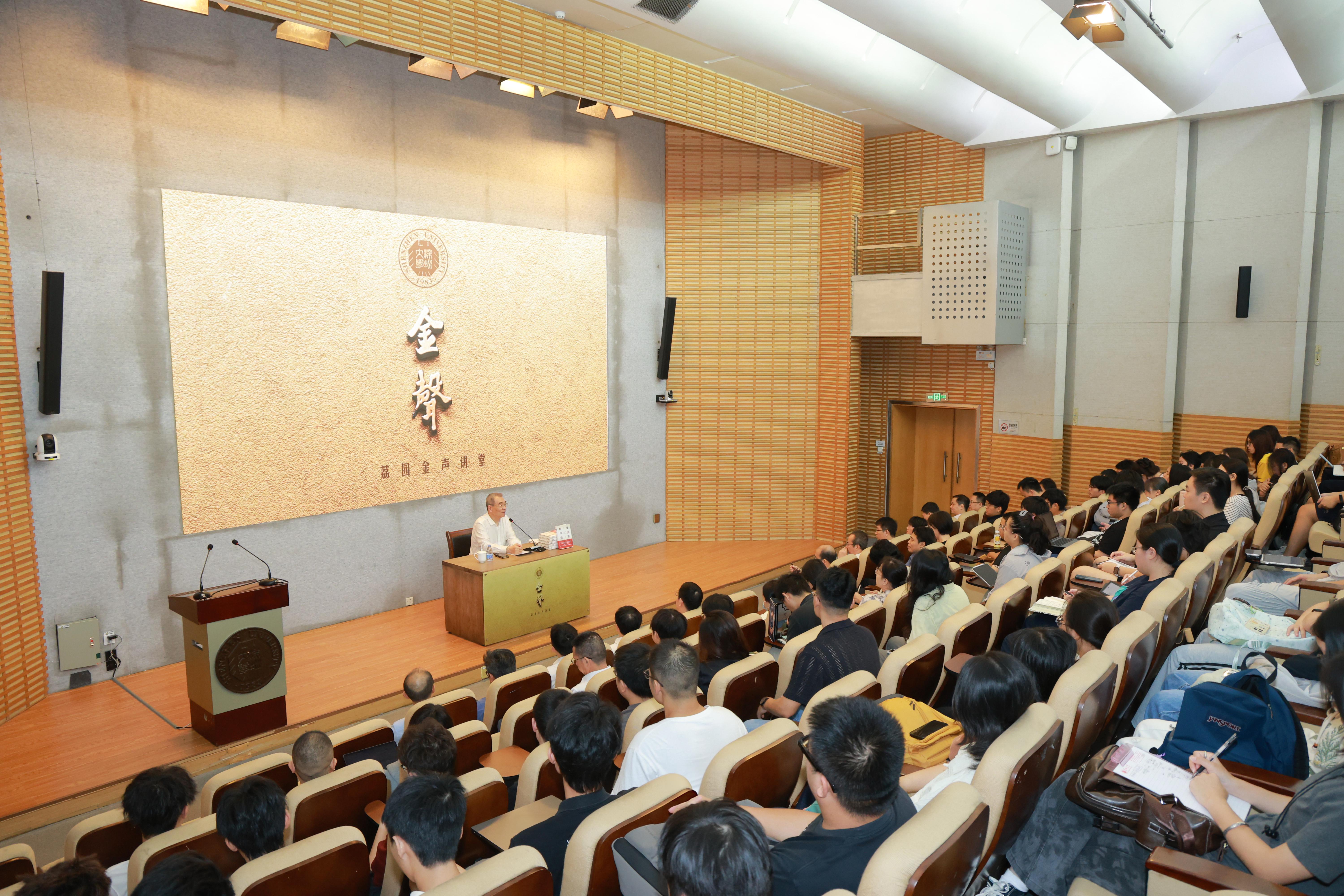
On October 10, Professor Justin Yifu Lin, Dean of Peking University's Institute of New Structural Economics, delivered a keynote lecture on "Great Changes Unseen in a Century and Independent Theoretical Innovation in New Structural Economics" at Shenzhen University. Xu Bo, Secretary of the CPC Shenzhen University Committee (Party Secretary Xu Bo), and Vice Presidents Chao Naipeng and Li Meng attended the event. Chao Naipeng chaired the session, which was attended by hundreds of faculty members and students.
Justin Yifu Lin is the first scholar from a developing country to serve as Chief Economist of the World Bank. He was elected a Fellow of the Econometric Society on October 8 and has long served on the Strategic Advisory Committee of Shenzhen University.
At the lecture, drawing on long-term data, Justin Yifu analyzed the economic essence of the great changes unseen in a century. He noted that the 2008 global financial crisis marked a key turning point in the transformation of the global governance system, that China has become a key force shaping the global landscape, and that the country should leverage its latecomer advantages and the opportunities presented by the technological transformation of the Fourth Industrial Revolution to achieve high-quality development.
Drawing on the theory of latecomer advantages, Lin offered his assessment of China's medium- and long-term economic growth prospects, noting that technological innovation and industrial upgrading are the core of long-term economic growth and the fundamental underpinning of cultivating new quality productive forces. He explained the core paradigm of New Structural Economics: the industrial and technological structure is endogenously determined by the factor endowment structure, and industrial upgrading must follow the comparative advantage. He further argued that an effective market takes a facilitating government as its premise, and a facilitating government takes an effective market as its ultimate goal. Turning to the age of AI, he drew a distinction between two paths: one is to build AI itself into an industry, and the other is to use AI to upgrade existing industries. He stressed that efforts to develop new quality productive forces must build on a country's own strengths.
During the Q&A session, Lin addressed questions on topics ranging from local government debt resolution to industrial upgrading in the AI era, and encouraged young students to ground their economics research in real-world practice. Chao Naipeng said in his closing remarks that the lecture, richly supported by data and rigorously argued, offered valuable insights into global shifts and China's path of economic development.