On March 30, 2026, a research team led by Professor Wang Dan from the State Key Laboratory of Intelligent Construction and Healthy Operation and Maintenance of Deep Underground Engineering at Shenzhen University (hereinafter referred to as the State Key Laboratory) published a paper online in Nature Sustainability, titled "Spatially coupled adsorption and catalysis for sustainable lithium-sulfur batteries." This study constructs a sp-nitrogen-doped graphdiyne hollow multi-shelled structure (HoMS). Based on this architecture, the authors propose a novel electrode design strategy featuring spatially coupled adsorption and catalysis, which provides strong support for the development of high-energy-density and sustainable lithium-sulfur batteries. This work also represents a significant breakthrough in the State Key Laboratory's key research direction of "green energy development of deep earth, deep sea, and deep space" (low-carbon green energy theory and technology).
Lithium-sulfur batteries are regarded as promising candidates for next-generation energy storage technologies due to their ultrahigh theoretical energy density, as well as the abundance and low cost of sulfur. However, their practical applications have long been hindered by critical challenges, including the polysulfide shuttle effect, sluggish reaction kinetics, and performance degradation under high sulfur loading conditions. Traditional strategies typically rely on large amounts of host materials or catalysts. Although these approaches improve stability, they inevitably introduce excessive inactive mass, thereby reducing the overall energy density of the battery. To address this fundamental trade-off, the research team constructs a sp-nitrogen-doped graphdiyne hollow multi-shelled structure (sp-N GDY HoMS), enabling spatial coupling between adsorption and catalytic sites within the material. The structure enhances electron transport and charge redistribution through orbital overlap, which not only strengthens polysulfide adsorption but also significantly accelerates redox reaction kinetics, thereby achieving a balance between efficient catalysis and lightweight design. Benefiting from this design, the system achieves an ultrahigh sulfur loading of 93.9% under conditions close to practical applications, delivering a specific capacity approaching the theoretical limit (1,462 mAh g⁻¹, based on the total mass of sulfur and host materials). The cell maintains excellent performance at a high rate of 10C and exhibits stable cycling over 600 cycles. In addition, the pouch cell delivers an energy density of approximately 457 Wh kg⁻¹, demonstrating strong potential for practical applications.
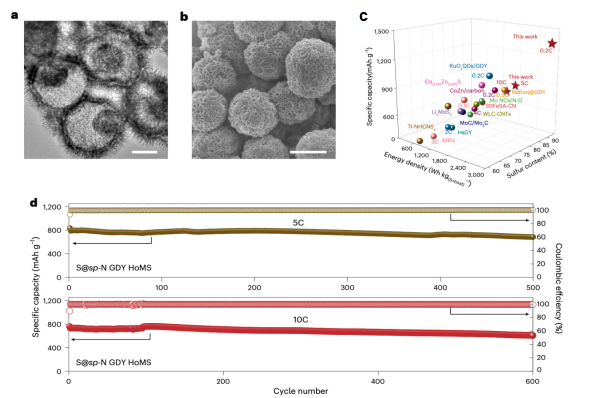
Figure: Sp-nitrogen-doped graphdiyne hollow multi-shelled structure (HoMS) developed in this work and its key performance in lithium-sulfur batteries
Mechanistic studies indicate that the synergistic effect between sp-nitrogen sites and adjacent carbon atoms is critical to the performance enhancement. The resulting high-density polar active sites simultaneously facilitate both the anchoring and conversion of polysulfides. In addition, the hierarchical spatial confinement and efficient ion-transport channels provided by the multi-shelled structure significantly improve reaction kinetics and structural stability of the system.
This study overcomes the long-standing trade-off between energy density and cycling stability in lithium-sulfur batteries. It proposes a generalizable material design paradigm, providing new insights into the development of high-performance and resource-efficient next-generation energy storage systems. This work is of significant importance for advancing the industrialization of green energy storage technologies and will provide key support for energy storage technologies in the State Key Laboratory's "three-deep" energy resource development and utilization program.
The first affiliated institution for this work is the State Key Laboratory of Intelligent Construction and Healthy Operation and Maintenance of Deep Underground Engineering at Shenzhen University.
Paper link: https://www.nature.com/articles/s41893-026-01794-y