While humans use "sunscreen" to shield against UV radiation, maize has evolved its own natural defense. Recently, a research team led by Liu Hongtao, Dean and Distinguished Professor of the College of Life Sciences and Oceanography at Shenzhen University, published a research paper inNature Communications, revealing this secret for the first time: the blue light receptor in maize, known as ZmCRY1s, can perceive blue light signals and directly bind to GLOSSY2, a BAHD family acyltransferase involved in wax synthesis. This blue light-strengthened interaction modulates the composition and accumulation of epidermal waxes, thereby significantly enhancing the plant's UV-B stress tolerance.
This achievement not only elucidates a new mechanism for plant stress resistance but also embodies multiple innovative breakthroughs, providing a crucial target for cultivating more sun-resistant and high-light-efficiency maize varieties. Professor Liu Hongtao's team also collaborated with Researcher Zhang Peng from the CAS Center for Excellence in Molecular Plant Sciences, to resolve the structure of the ZmCRY1s-GLOSSY2 protein complex. This work was recently published inScience Advances, offering direct evidence for the molecular basis of light signal transduction.
Blue light receptor: maize's "sunscreen conductor"
Maize is the world's highest-yielding grain crop. It thrives on sunlight but can also suffer from overexposure. Intense sunlight in the field, particularly UV-B radiation, can damage the leaf photosynthetic system, cause DNA lesions, induce ROS stress, and reduce yield. However, maize has its own "sunscreen"—the epidermal wax layer on the surface of its leaves, which can reflect and absorb most ultraviolet rays. The composition and thickness of this "sunscreen" are regulated by light, but the mechanism by which light regulates epidermal wax remains an unsolved mystery.
In normal maize exposed to blue light, the mesocotyl (the part that elongates in soil during germination and whose growth is inhibited upon light exposure) shortens, while epidermal wax thickens and undergoes compositional changes. The "eyes" through which maize perceives blue light contain three ZmCRY1s (ZmCRY1a, ZmCRY1b, and ZmCRY1c) and one ZmCRY2. The team constructed a "CRY-all-inactivated" maize mutant (cry-q) through gene editing. By comparing normal maize with "better-sighted" CRY-overexpressing maize, they found that in normal maize, the mesocotyl shortens and the epidermal wax thickens when exposed to blue light. However, as the "blue light vision" capability declined, the cry-q material not only became insensitive to blue light but also extremely susceptible to ultraviolet rays. Conversely, CRY-overexpressing maize gained stronger "sunscreen ability." More critically, blue light significantly increases C32 aldehyde in maize wax. C32 aldehyde is a key intermediate product in the maturation of maize wax components, and its accumulation depends on the "command" of ZmCRY1s. Even under blue light, the mutant struggled to synthesize C32 aldehyde.
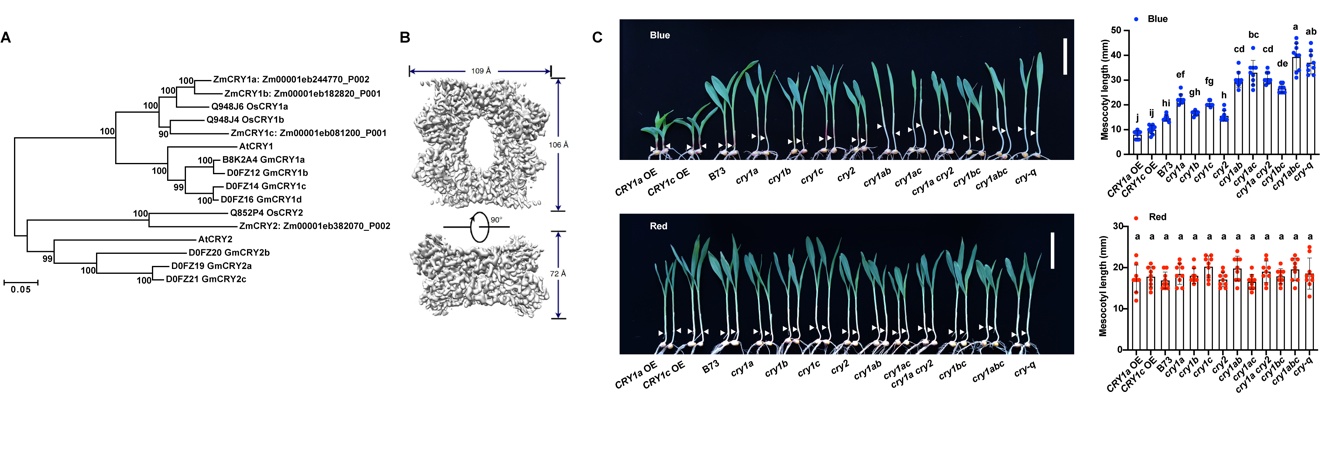 A. Phylogenetic analysis of CRYs; B. Structure of ZmCRY1c-PHR; C. Involvement of ZmCRYs in blue light signaling for photomorphogenesis
Molecular partners: "protein collaboration" under blue light
How do ZmCRY1s "command" the production of C32 aldehyde? The team identified its "partner"—the GLOSSY2 (GL2) protein.
GL2 is a key protein for synthesizing wax raw materials (ultra-long-chain fatty acids). In the dark, it cooperates with the KCS6 protein to synthesize ultra-long-chain fatty acids. However, after blue light activates ZmCRY1s, they compete with KCS6 (with a 78% overlap in their binding interfaces on GL2), "taking over" GL2 to form a new partnership, which then synthesizes C32 aldehyde, thereby upgrading the wax "formula" and doubling its "sunscreen ability."
To visualize this process, the team, in collaboration with Researcher Zhang Peng's team, also analyzed the 2.8Å 3D structure of ZmCRY1s bound to GL2 (recently published inScience Advances). This was akin to capturing a high-definition "protein handshake" photograph, confirming the critical role of blue light in their collaboration and further revealing the structural basis of competitive binding.
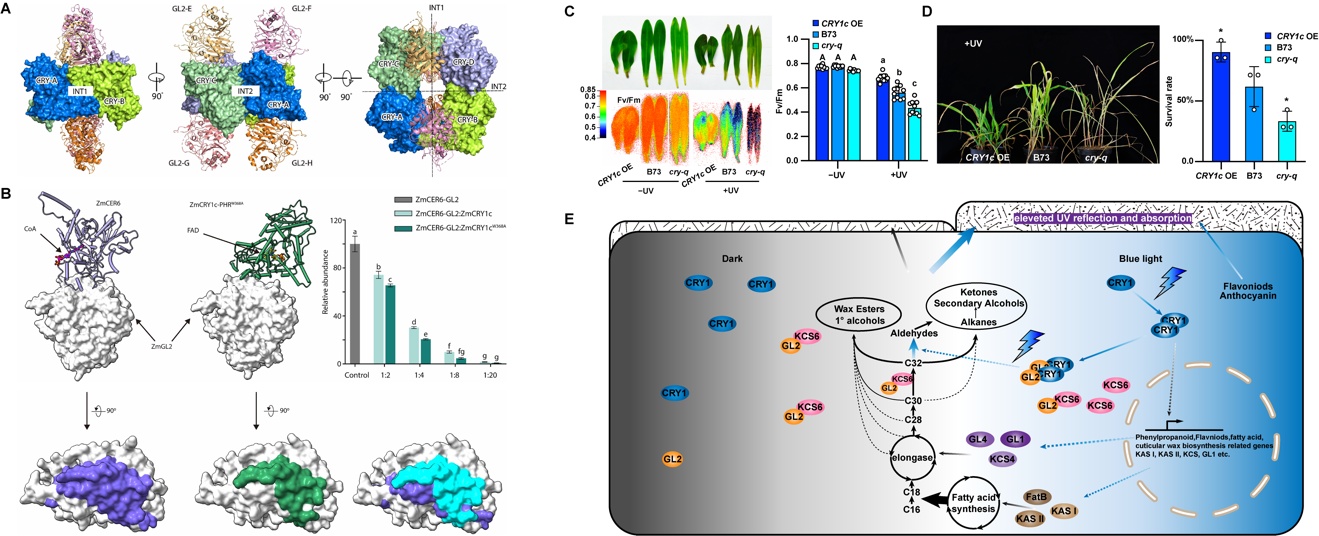
A. Structural analysis of ZmCRY1c-GL2; B. Structural basis of competitive binding of ZmCRY1c and KCS6 to GL2 (with a 78% overlap in their binding interfaces on GL2); C. ZmCRYs help resist UV damage to the photosynthetic system; D. ZmCRYs enhance UV resistance in maize; E. Mechanism by which ZmCRYs regulate wax synthesis and enhance UV resistance in maize
Core innovation and application value: breaking traditional understanding and opening new breeding pathways
The research findings published inNature Communicationswere supported by the National Key Research and Development Program of China and the National Natural Science Foundation. Co-first authors are Zhao Zhiwei, Associate Researcher of Shenzhen University, as well as Feng Fan, Postdoctoral Fellow, Liu Yaqi, Postdoctoral Fellow, and Liu Yawen, Associate Researcher from the CAS Center for Excellence in Molecular Plant Sciences. Liu Hongtao is the corresponding author. The research findings published inScience Advanceswere supported by the National Key Research and Development Program of China and the National Natural Science Foundation. Co-first authors are Liu Yaqi and Zhao Zhiwei. Co-corresponding authors are Zhang Peng and Liu Hongtao. Professor Liu Hongtao's team has long focused on "mechanisms of light-regulated plant development and environmental adaptation." These new findings further expand the field of plant light signaling regulation research and add new achievements to Shenzhen University's agricultural biotechnology research.
This research achieved a triple breakthrough, opening up new perspectives for crop stress resistance research and practice:
Breaking the traditional regulatory paradigm – This is the first discovery that a plant photoreceptor can directly bind to a metabolic enzyme to regulate metabolic processes, challenging the classical framework where light signals regulate metabolism through gene expression. ZmCRY1s bypass transcriptional steps and directly interact with GL2 to redirect metabolic flux, enabling rapid and precise translation of light signals into metabolic responses. This elucidates a novel paradigm for understanding the efficient regulatory mechanisms of plant environmental adaptation. This also brings new insights, suggesting that similar mechanisms of direct light-regulated metabolism may exist in humans and animals.
Cracking a core mystery in the field – The study clarifies the molecular mechanism by which ZmCRY1s-GL2 direct interaction mediates C32 aldehyde accumulation, providing a key molecular clue for the long-unresolved research problem of ultra-long-chain fatty aldehyde synthesis in plants.
Empowering crop stress-resistant breeding – The revealed ZmCRY1s-GL2 regulatory module provides a precise target for improving UV-B tolerance in crops such as maize, offering technical support for cultivating stable, high-yield varieties in regions with high temperatures, strong light, and intense UV radiation. This effectively addresses agricultural challenges brought by global climate change.
Original link:
https://www.nature.com/articles/s41467-025-67587-7
https://www.science.org/doi/10.1126/sciadv.adz0136