On November 26, Shenzhen University hosted the launch of the Society Zero Universe LLMs social simulation platform, organized by the Office of Social Science, and co-organized by the School of Media and Communication and the College of Computer Science and Software Engineering. The event took place in Meeting Room 438 of Huiyuan Building at the Yuehai Campus. Experts and scholars from leading institutions including Tsinghua University, Peking University, Fudan University, and Renmin University of China gathered to explore new methodologies and pathways for social science research in the intelligent era.
Mao Junfa, President of Shenzhen University and Academician of the Chinese Academy of Sciences, emphasized that the official release of the Society Zero Universe LLMs social simulation platform, witnessed by colleagues from academia and industry, marks a pivotal step in Shenzhen University's advancement of the new liberal arts.
The platform had already been designated as a key project for liberal arts development at Shenzhen University's first Liberal Arts Conference on June 27. This launch not only represents a bold interdisciplinary initiative but also highlights the university's academic trajectory toward integrating liberal arts with sciences, and liberal arts with engineering.。
Vice President Chao Naipeng noted that Society Zero Universe is not only a universal platform serving research and teaching across the university but is also deeply embedded in the overall strategic plan for liberal arts development. It reflects Shenzhen University's academic foundation in reform and opening-up studies while closely aligning with the evolving needs of Shenzhen's local economy, society, and strategic emerging industries.
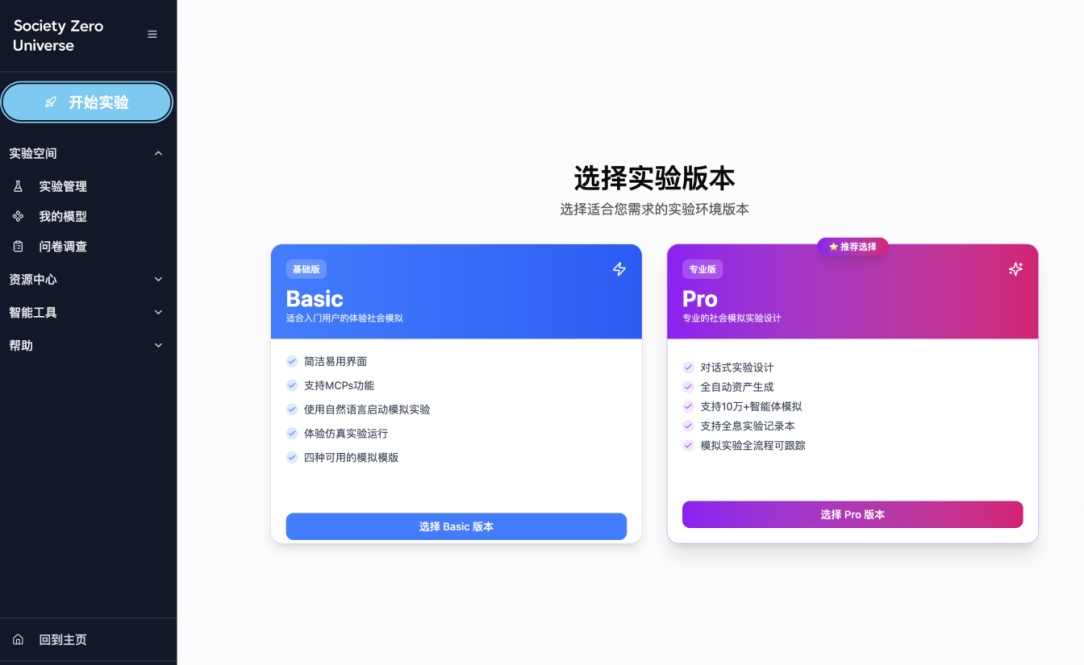
The platform leverages large language models as its cognitive core to build a multi-agent collaborative social simulation system. It features four core strengths: guiding research through the humanities and social sciences; enabling researchers to transform theoretical ideas into simulation experiments; providing a generative workflow where users can create agents, spaces, logic, and processes simply through natural language; and offering an innovative Model Context Protocol (MCP) that functions like a "USB interface," flexibly connecting to external data sources such as maps, news, and finance. A comprehensive data capture mechanism records both environmental changes and agents' thought processes.
Technically, the platform is supported by five pillars: a hybrid agent framework balancing large-scale simulation efficiency with high cognitive fidelity for key individuals; a full-stack agent architecture supporting MCP and A2A multi-agent interaction protocols; natural language-driven control enabling zero-code complex simulations; and a research-grade experimental foundation ensuring visibility, controllability, and reproducibility.
These innovations significantly lower the barrier for social science researchers while ensuring scientific rigor and cutting-edge relevance. They signal that artificial intelligence is profoundly reshaping the boundaries and methodologies of social science research.
At the launch, Shenzhen University, together with Tsinghua University, Fudan University, and Renmin University of China, issued a joint cooperation initiative advocating resource sharing and collaborative innovation under the principles of "openness, interconnectedness, and sharing."
In the discussion session, guests from various universities showcased their own large-model social simulation platforms and shared insights from model development and practical case studies.