On December 25, Shenzhen University officially launched the Shenzhen University Intelligent Computing Center at the Huiyan Building on Yuehai Campus. The ceremony was attended by Mao Junfa, President of Shenzhen University and Academician of the Chinese Academy of Sciences, along with Vice President Chao Naipeng, heads of various university departments, and representatives from partner units such as Huawei and Tencent. The launch of the center represents a significant milestone in Shenzhen University's ongoing "Double First-Class" initiative and its strategy to develop into a world-class innovative university.
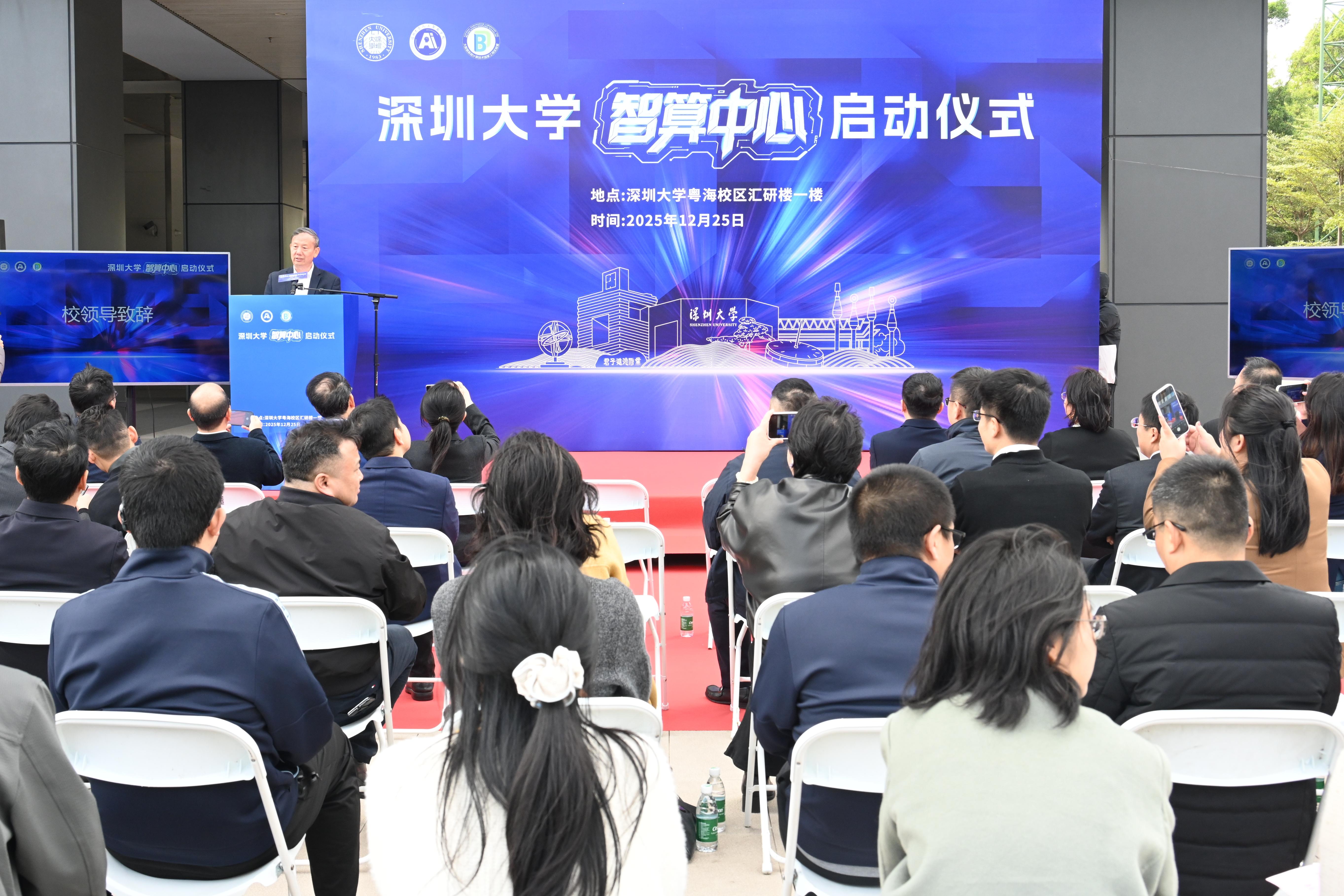
In his address, President Mao Junfa highlighted that the Intelligent Computing Center is a milestone in Shenzhen University's "Double First-Class" initiative, signifying the university's leap from a follower to a leader in computing power infrastructure. The center will serve as a "super brain" for scientific research, a "smart laboratory" for teaching, and an "innovation platform" for interdisciplinary studies, promoting the deep integration of new engineering, new medicine, and new liberal arts. Additionally, it will be open to external users, serving the construction of the Guangdong-Hong Kong-Macao Greater Bay Area and the Shenzhen Pilot Demonstration Zone.
The Shenzhen University Intelligent Computing Center provides integrated computing power support for over 40,000 faculty members and students across the university. On the hardware layer, it integrates GPU/CPU supercomputing and large-scale storage resources (318 PFlops@FP16 GPU computing power, 5000+ CPU cores, 6 PB storage), equipped with a 200 Gbps high-speed interconnected network to ensure security. On the software layer, it integrates new-generation information technology to provide secure and flexible computing power and data services.
At the launch ceremony, the university unveiled "FROGENT," an intelligent full-process drug design system developed on the center's platform. FROGENT automates drug discovery, improving R&D efficiency and reducing costs. The university also featured the presentation of honorary certificates to partner organizations and the announcement of an "AIGC Short Video Generation Competition" designed to encourage students to explore the center's capabilities.
Attendees, including Mao Junfa, took part in a ribbon‑cutting ceremony and toured the center's exhibition hall and equipment rooms. Currently, the intelligent computing platform (https://console.aicloud.szu.edu.cn/) is now open for free trial use by Shenzhen University faculty, students, and external researchers. Interested users can log in to apply for access.